Why AI Agents and the Model Context Protocol Are Reshaping the Digital Economy
Artificial intelligence has dominated the technology industry for more than three years. The first phase was driven by chatbots and large language models. Companies rushed to integrate conversational AI into products, customer support systems, search engines, productivity software, and enterprise workflows.
That phase is ending.
The most important trend in technology today is the rise of AI agents powered by the Model Context Protocol, commonly known as MCP. While blockchain, decentralized finance, tokenization, and digital assets continue to evolve, the center of gravity in the technology sector has shifted toward agentic AI. Investors, software companies, cloud providers, startups, and enterprise executives are now focused on one question:
How do you turn AI from a system that answers questions into a system that performs actions?
That question is creating an entirely new software ecosystem.

From Chatbots to Agents
The first generation of AI products functioned as assistants. Users asked questions. Models generated responses. The interaction ended there.
The next generation is fundamentally different.
AI agents are designed to execute tasks, interact with software tools, retrieve information from databases, communicate with applications, make decisions within predefined boundaries, and complete workflows with minimal human intervention.
Instead of asking an AI model to summarize sales reports, an AI agent can retrieve reports from multiple databases, analyze performance metrics, identify anomalies, generate recommendations, draft executive summaries, and distribute those summaries across an organization.
The distinction is critical.
A chatbot provides information.
An agent performs work.
That difference explains why some analysts view AI agents as the biggest software shift since cloud computing.
Research analyzing more than 177,000 MCP tools found that software development alone accounts for approximately 67 percent of agent tools and roughly 90 percent of MCP server downloads. The study also found that action oriented tools grew from 27 percent to 65 percent of usage during the observed period, demonstrating a rapid shift from information retrieval toward execution.
The market is moving from intelligence to automation.
The Rise of the Model Context Protocol
The technology enabling this transition is MCP.
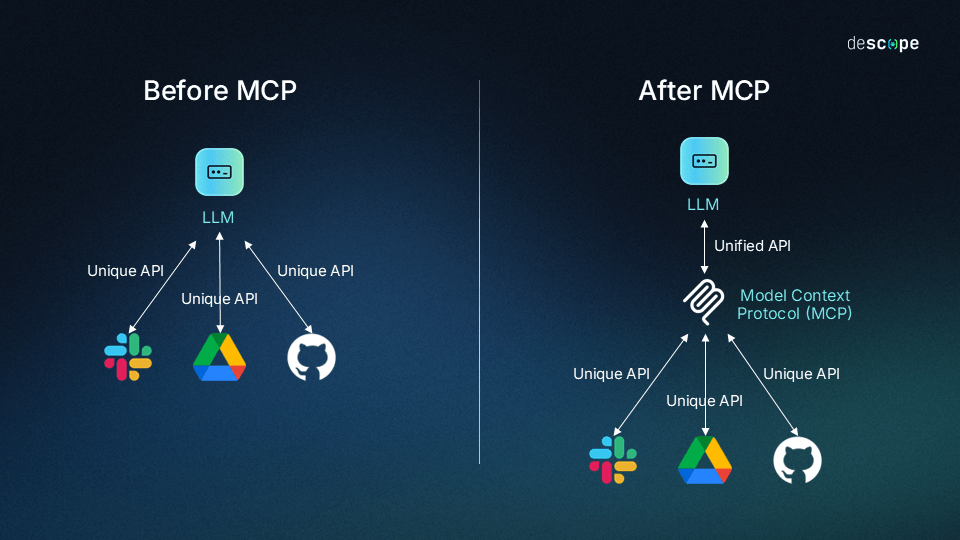
Introduced by Anthropic in late 2024, the Model Context Protocol was designed to solve one of AI's biggest limitations: connectivity.
Traditionally, every AI application required custom integrations for databases, APIs, cloud platforms, internal software, and business systems. This created massive complexity.
MCP establishes a standardized way for AI systems to connect with external tools and data sources.
Many engineers now describe it as the equivalent of USB-C for AI systems because it creates a universal connection layer between AI models and software infrastructure.
The speed of adoption has been remarkable.
Industry reports indicate that MCP has expanded to thousands of servers and tens of millions of monthly SDK downloads while receiving support from major AI companies including OpenAI, Google, Microsoft, and Anthropic.
This growth is significant because technology history repeatedly shows that standards often become more valuable than individual products.
The internet scaled because of common protocols.
Mobile applications scaled because of standardized operating systems.
Cloud computing scaled because of shared infrastructure models.
AI agents are now scaling because of shared connectivity standards.
Why Enterprises Are Paying Attention
The excitement surrounding AI agents is not driven by consumer applications alone.
Large enterprises are becoming the primary battleground.
Most organizations have already experimented with generative AI. Many deployed chat interfaces, internal assistants, or productivity tools. However, a large percentage struggled to generate measurable business value. Reports indicate that while AI adoption is widespread, far fewer organizations report meaningful financial impact.
The reason is straightforward.
Knowledge alone does not create economic value.
Execution does.
An AI system that provides recommendations is useful.
An AI system that performs operational work can transform business economics.
This explains why enterprise investment is increasingly focused on agent infrastructure, workflow orchestration, governance systems, and interoperability standards rather than standalone chat experiences.
Organizations are attempting to build digital workforces capable of handling repetitive processes across departments.
Potential use cases include:
Customer service automation
Software development assistance
Financial reporting
Compliance monitoring
Supply chain management
Marketing operations
Internal knowledge retrieval
Human resources workflows
The goal is not merely reducing labor costs.
The goal is increasing operational throughput.
Companies want more output without proportional increases in headcount.

The New Infrastructure Race
One of the most overlooked developments in the AI sector is the emergence of an entirely new infrastructure layer.
Much of the public discussion focuses on AI models.
The larger opportunity may lie elsewhere.
As enterprises deploy AI agents at scale, they require:
Authentication systems
Context management frameworks
Workflow orchestration platforms
Monitoring tools
Security infrastructure
Agent communication protocols
Memory systems
Governance controls
These requirements are creating a new category of enterprise software.
The market is beginning to resemble the early cloud era.
When cloud computing emerged, companies initially focused on virtual machines and storage. Over time, the real value migrated toward orchestration, security, observability, deployment systems, and platform management.
AI agents appear to be following the same pattern.
Recent enterprise research highlights infrastructure, MLOps platforms, and developer tooling as key drivers of the next phase of AI adoption.
The companies building these layers may become some of the most valuable businesses of the next decade.
The Security Challenge
Every technological revolution creates new risks.
AI agents are no exception.
The moment an AI system gains the ability to interact with external tools, modify data, send messages, execute transactions, or control software environments, security becomes dramatically more important.
Researchers studying the MCP ecosystem have identified several areas of concern, including unauthorized access, prompt injection, privilege escalation, malicious tool manipulation, and supply chain vulnerabilities.
This challenge has become one of the biggest barriers to enterprise deployment.
Many organizations are enthusiastic about AI agents but reluctant to grant them meaningful operational authority.
Trust remains a major issue.
Industry reporting shows that only a small percentage of companies fully trust AI systems to manage core operations autonomously.
As a result, governance is emerging as a major competitive differentiator.
The winning AI platforms may not necessarily be those with the smartest models.
They may be the platforms with the strongest controls.

Multi Agent Systems Are Emerging
Another important trend is the transition from individual agents to coordinated networks of agents.
Early AI systems relied on a single model performing all tasks.
Modern architectures increasingly distribute work across specialized agents.
One agent may conduct research.
Another may validate information.
A third may execute actions.
A fourth may perform compliance checks.
This architecture resembles the evolution of software from monolithic systems toward microservices.
Instead of one massive application doing everything, organizations build collections of specialized services that work together.
The same transformation is now occurring within AI. Community discussions and industry analyses increasingly point toward multi agent orchestration as a defining trend of 2026.
This development creates new opportunities for software companies focused on coordination, communication, and workflow management.
The future may not belong to a single super-intelligent agent.
It may belong to ecosystems of specialized agents working together.
The Economic Impact
The economic implications are enormous.
Historically, software automated information processing.
AI agents automate decision making and execution.
That distinction could unlock productivity gains across nearly every industry.
The most valuable organizations of the next decade may be those that successfully integrate agentic systems into core operations.
Financial services firms could automate large portions of reporting and analysis.
Manufacturers could automate supply chain coordination.
Healthcare organizations could streamline administrative workflows.
Software companies could accelerate development cycles.
Marketing teams could automate campaign execution.
This explains why venture capital investment continues flowing aggressively into the AI infrastructure ecosystem.
Investors are no longer betting solely on models.
They are betting on the operational layer that sits on top of those models.

What This Means for Blockchain
The rise of AI agents also has significant implications for blockchain.
For years, blockchain advocates promoted the concept of programmable value.
AI agents introduce programmable decision making.
The intersection of these technologies could become one of the most important developments of the decade.
Imagine autonomous agents capable of:
Managing crypto treasuries
Executing decentralized finance strategies
Monitoring smart contracts
Managing tokenized assets
Conducting automated compliance checks
Operating decentralized organizations
Blockchain provides transparent execution.
AI provides intelligent decision making.
Together, they create systems capable of operating with minimal human intervention.
While many of these applications remain early stage, the convergence is attracting increasing attention from developers, investors, and protocol builders.
The Cost Problem Nobody Talks About
Despite the excitement, significant obstacles remain.
One of the most important is cost.
Agentic systems consume substantially more resources than traditional chatbot interactions because they operate continuously, invoke multiple tools, perform reasoning steps, and execute workflows.
Enterprise leaders are increasingly scrutinizing AI spending and demanding measurable returns on investment. Reports show growing concern regarding rising AI costs across corporate environments.
This creates pressure on the entire ecosystem.
Companies can no longer rely on hype.
They must demonstrate value.
The next phase of AI competition will be determined by economics.
The organizations that deliver reliable outcomes at sustainable costs will win.
The Next Decade
Every major technology cycle produces a foundational layer that changes everything built on top of it.
The internet had TCP/IP.
The web had HTTP.
Mobile computing had iOS and Android.
Cloud computing had virtualization and containerization.
Agentic AI appears to be converging around MCP and related interoperability standards.
The broader shift is even more important than the protocol itself.
Technology is moving from systems that generate information to systems that perform actions.
That transition changes the economic value of AI.
The biggest winners may not be chatbot companies.
They may be the firms building the infrastructure, security, governance, orchestration, and interoperability layers required to make autonomous digital workforces reliable at scale.
The current AI boom began with conversation.
Its next chapter is execution.
That is where the largest opportunities are emerging, where enterprise spending is accelerating, and where the future of software is being built.


Comments
Post a Comment